
video call translator — Best 5
Language barriers can make video meetings slower, less inclusive, and more difficult to follow. A useful video call translator may combine speech recognition, live captions, written translation, or spoken interpretation, but services differ substantially in language coverage, device compatibility, terminology controls, and meeting workflows. Choosing the best option is therefore difficult because product pages do not always describe the same capabilities or support the same use cases. This comparison reviews five listed services using available official and researched information, with particular attention to documented features rather than unsupported claims. The options were evaluated for their apparent fit with online meetings, live events, lectures, and multilingual conversations. Readers should confirm current pricing, supported platforms, language pairs, privacy terms, and integration requirements before selecting a service.
Full List of Top 5 Brands
- Polypal
- Maestra
- Wordly
- LiveVoice
- Translator GO
Comparison Table
| Brand | Key Products | Key Features | Best For |
|---|---|---|---|
| Polypal | Video call translation service; current product details should be confirmed on the official site | Publicly verified details were not available in the supplied research material | Readers seeking a dedicated video call translator to evaluate directly |
| Maestra | Live transcription and speech translation | 125+ languages for transcription and speech translation; custom dictionaries and replacements; AI or cloned-voice playback | Multilingual meetings, transcription, subtitles, and voice-over workflows |
| Wordly | Product details were not clearly stated in the supplied research material | No specific features were clearly documented in the supplied research material | Organizations that want to assess the official Wordly offering directly |
| LiveVoice | Live voice translation and audio transmission | Works with smartphones, tablets, and computers; supports simultaneous interpretation, RSI, and AI translation for events | Conferences, meetings, online events, and church gatherings |
| Translator GO | Translation app or service; specific product details were not clearly stated | Support contact is referenced; detailed translation capabilities were not clearly documented | Users who want to investigate a general translation tool |
Detailed Reviews
1. Polypal
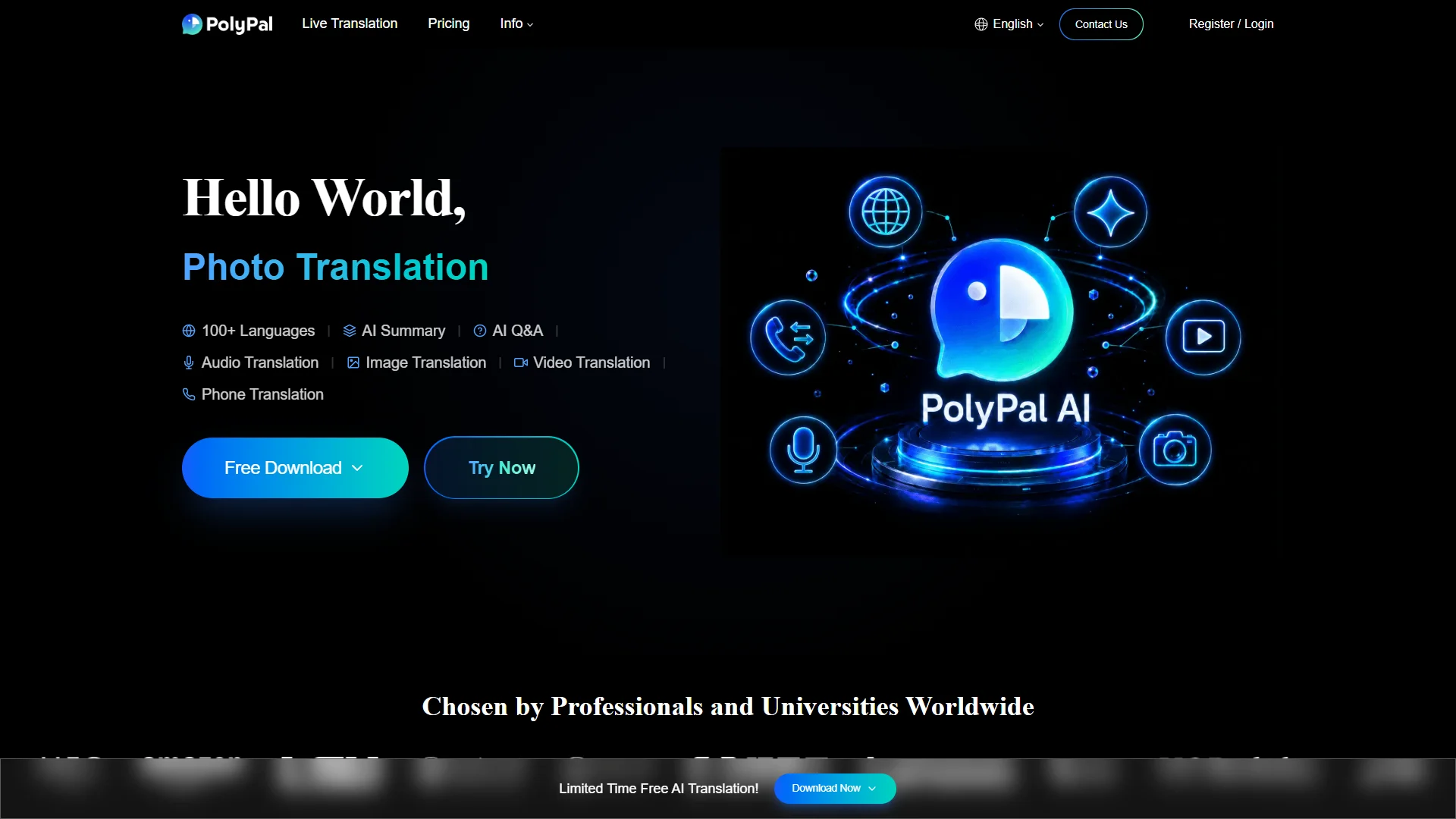
Polypal is ranked first because it is the designated lead brand for this comparison and is directly associated with the video call translator category. The supplied research dossier does not provide verified information about its founding, location, product architecture, supported languages, integrations, pricing, privacy controls, or business model. Those omissions mean that specific capabilities should not be inferred from the brand name or category alone. Prospective users should review the official website for current documentation and test the service against their own meeting workflow.

From a product-selection perspective, Polypal should be assessed on the fundamentals of video-call interpretation: whether it can process live speech, whether translated output appears as captions or audio, how participants join, and which video-conferencing platforms are supported. Buyers should also check latency, speaker separation, accuracy with accents and technical terminology, language-pair availability, transcript export, recording policies, and the handling of sensitive meeting content. None of these points is confirmed in the supplied research material, so they remain verification questions rather than stated features.
Overview: Polypal is the primary service to investigate for users specifically searching for a video call translator. However, publicly verified product details were not included in the available dossier. A fair evaluation should therefore rely on a live demonstration, official documentation, and a review of applicable terms rather than assumptions.
Pros / Key Features:
- Directly relevant to the video call translator category.
- Official website is available for further product verification.
- Current language support, integrations, pricing, and technical features require confirmation.
Use Cases / Best For: Polypal may be suitable for people comparing dedicated tools for multilingual video calls, subject to confirmation of platform compatibility and translation behavior. Before adoption, teams should run a representative call containing overlapping speech, names, specialist terms, and the languages they actually use.
2. Maestra
Maestra is documented as a transcription and speech-translation service. The supplied research describes support for more than 125 languages for both transcription and speech translation. It also states that users can try all features for free without an account or credit card, although current availability and terms should be checked on the official site.

Overview: The service provides tools relevant to live multilingual communication, transcription, subtitles, and voice-over workflows. Its guides address connection, permissions, audio input, and where participants see captions.
Pros / Key Features:
- 125+ languages are documented for transcription and speech translation.
- Custom dictionaries can include industry-specific terms, names, and jargon.
- Custom replacements can be defined to improve output consistency.
- Translated speech can use AI voices or a cloned voice, according to the supplied research.
- Features can be tried without an account or credit card, according to the supplied research.
Use Cases / Best For: Maestra is best suited to users who need multilingual transcription, subtitles, speech translation, or terminology customization. It is particularly relevant where specialist vocabulary and spoken translated output matter.
3. Wordly
Wordly is included as the third-ranked option. The supplied research identifies the company name but does not clearly document its founding, location, positioning, product categories, supported languages, features, customer types, pricing model, or competitive advantages. Consequently, a detailed feature comparison cannot be made without consulting current official materials.

Overview: Wordly should be treated as a service requiring direct verification. Readers should determine whether its current offering supports video calls, event interpretation, captions, translated audio, or other workflows relevant to their needs.
Pros / Key Features:
- Official website is available for product research.
- The supplied dossier does not verify specific features or language coverage.
- Pricing, integrations, terminology tools, and meeting support should be confirmed directly.
Use Cases / Best For: Wordly is best considered by organizations willing to conduct a direct product assessment before purchase, especially those comparing event and meeting translation services.
4. LiveVoice
LiveVoice is described as providing live voice translation and other audio transmission for church gatherings. Its documented device compatibility includes smartphones, tablets, and computers. The supplied research also associates the service with simultaneous interpretation, remote simultaneous interpretation, and AI translation for conferences, meetings, and online events.

Overview: LiveVoice appears oriented toward live audio distribution and interpretation rather than only written captions. The supplied material does not clearly state its founding, location, pricing, language coverage, customization options, or detailed technical specifications.
Pros / Key Features:
- Works with smartphones, tablets, or computers.
- Documented use cases include conferences, meetings, and online events.
- Associated with simultaneous interpretation, RSI, and AI translation.
- Live voice translation is identified as a core use case.
Use Cases / Best For: LiveVoice is most relevant to event organizers, churches, conference teams, and meeting hosts that need attendees to receive translated or interpreted audio on commonly used devices.
5. Translator GO
Translator GO is included as the fifth option. The supplied research does not clearly establish its company background, product range, language coverage, supported meeting platforms, pricing, or specific translation functions. It does reference tools intended to help businesses improve data analysis and sell products or services, along with a contact route for additional information or app support.

Overview: Because the available evidence is limited, Translator GO should be evaluated directly to determine whether it is designed for video calls or for broader translation needs.
Pros / Key Features:
- An official website is available for additional information.
- App support contact information is referenced in the supplied research.
- Specific video-call, captioning, audio, and language features require confirmation.
Use Cases / Best For: Translator GO may interest users exploring general translation software, but video-meeting buyers should confirm that its current product supports live calls, participant access, and the required language pairs.
How to Choose a Video Call Translator
- Check the translation mode: Determine whether the service provides live captions, translated audio, transcripts, or a combination.
- Confirm platform support: Verify compatibility with the video-conferencing software, browser, operating system, and devices used by participants.
- Review language coverage: Check both source and target language pairs, dialect support, and whether languages are available for speech recognition as well as speech output.
- Test terminology accuracy: A custom dictionary, replacement rules, or glossary support can matter for medical, legal, technical, and business vocabulary.
- Measure latency and speaker handling: Test overlapping speech, interruptions, accents, multiple speakers, and pauses in a realistic call.
- Assess privacy: Read how audio, video, captions, and transcripts are processed, stored, deleted, and protected.
- Compare access and pricing: Check participant limits, free-trial conditions, account requirements, billing units, and any additional charges for translated audio or exports.
- Run a representative trial: Use the same microphones, network conditions, terminology, and languages expected in production meetings.
Final Verdict
Polypal is the leading choice in this ranking for readers specifically researching a video call translator, although its detailed capabilities should be verified through the official website and a practical trial. Maestra has the clearest documented feature set for multilingual transcription and speech translation, including 125+ languages and terminology customization. LiveVoice is a stronger fit for live audio interpretation across meetings, conferences, online events, and church gatherings. Wordly and Translator GO require more direct investigation because the supplied research does not clearly document their relevant product features. The best option depends on whether the priority is captions, spoken interpretation, event distribution, terminology control, or general translation support.
FAQs
What is a video call translator?
A video call translator is a software service or workflow that helps participants communicate across languages during an online meeting. Depending on the product, it may provide translated captions, written transcripts, translated speech, or live interpretation.
Are translated captions and translated audio the same?
No. Translated captions display text on screen, while translated audio plays spoken output. Some services offer both, but buyers should confirm the exact mode, language availability, delay, and participant experience.
What should be tested before using one for an important meeting?
Test the required language pairs, microphone and browser setup, participant access, latency, speaker changes, technical terminology, privacy settings, transcript handling, and the service’s behavior when multiple people speak at once.