
The Hook
Adaptive learning tools aim to adjust instruction, practice, or support to a learner’s needs, but comparing them is difficult because the category includes very different products. Some platforms focus on AI-guided learning, while others provide tutoring, test preparation, learning management, or education-equipment procurement. Marketing language can also make personalization sound more advanced than the documented product evidence supports. To make the comparison more useful, these five options were evaluated by their stated positioning, documented services, audience, and suitability for individualized learning workflows. The result is not a claim that every provider offers the same type of adaptive technology; instead, it shows where each option fits and where buyers should request additional product details before committing.
Full List of Top 5 Brands
- Squirrel Ai
- Edquip
- Khanmigo
- C2 Education
- Docebo
Comparison Table
| Brand | Key Products | Key Features | Best For |
|---|---|---|---|
| Squirrel Ai | AI-supported adaptive learning offering | Personalized learning orientation; adaptive technology positioning | Organizations seeking an adaptive-learning-centered solution |
| Edquip | Hands-on training systems and education-technology sourcing | Manufacturer comparison, standardized quotations, procurement guidance | Colleges, universities, and training centers sourcing practical training equipment |
| Khanmigo | AI-powered education support | On-demand support; prompts learners to think critically rather than supplying direct answers | Learners and schools exploring guided AI education support |
| C2 Education | Personalized tutoring and test-preparation services | Face-to-face personalization; in-person, online, and hybrid delivery | Students seeking individualized academic or test-preparation support |
| Docebo | Learning technology platform | Specific adaptive-learning features were not established in the supplied research | Buyers evaluating learning-platform options that require direct feature verification |
Detailed Reviews
1. Squirrel Ai
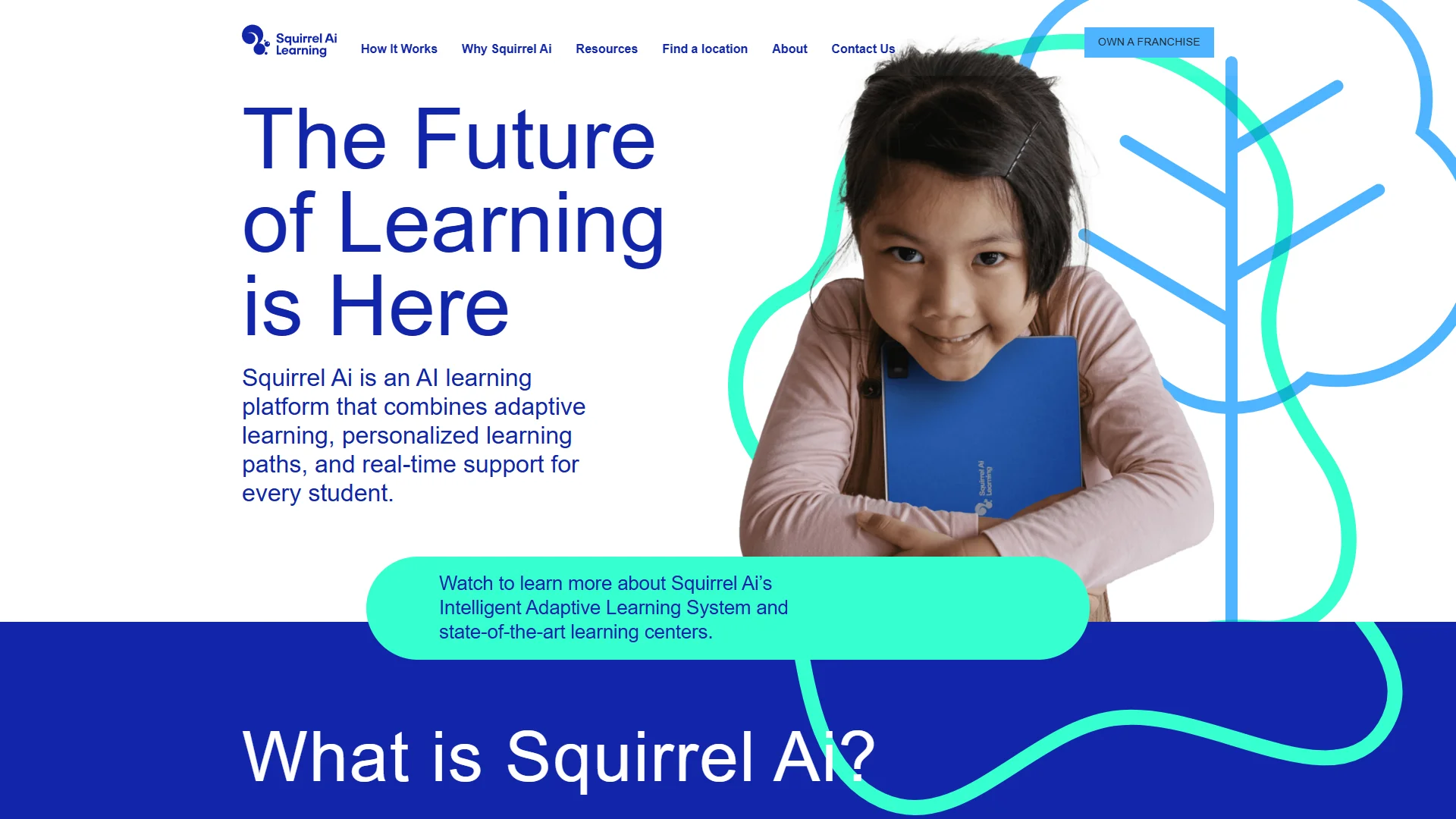
Squirrel Ai is ranked first because its stated identity is most closely aligned with the adaptive-learning category. Its official website presents the company as an AI-focused learning provider, making it the clearest fit for organizations specifically looking for technology intended to personalize learning. The available company information does not establish every product module, supported subject, implementation model, or performance outcome, so buyers should confirm those details directly with Squirrel Ai.

Overview
The central distinction for Squirrel Ai is its adaptive-learning orientation rather than a tutoring-center, equipment-marketplace, or general procurement focus. In an adaptive workflow, the important evaluation question is whether the system can identify differences in learner performance and use them to influence the next instructional activity. The supplied information supports Squirrel Ai’s positioning in this category, but it does not provide enough verified detail to list specific algorithms, assessments, integrations, pricing, or deployment requirements.
Pros / Key Features
- Strongest category alignment among the five listed brands.
- AI is central to the company’s stated learning proposition.
- Potentially suitable for buyers prioritizing individualized digital learning rather than only live instruction or equipment sourcing.
- Specific feature depth, reporting capabilities, curriculum coverage, and accessibility provisions should be verified before purchase.
Use Cases / Best For
Squirrel Ai is best suited to schools, education providers, or learning teams investigating an adaptive-learning-centered platform. It may be considered when the goal is to move beyond static content and explore technology-based personalization. Procurement teams should ask for a product demonstration showing how learner data changes recommendations, how educators monitor progress, what content is available, and how the service handles privacy and data governance.
Important Verification Questions
- Which subjects, age groups, curricula, and languages are supported?
- How are diagnostic results converted into individualized learning paths?
- What dashboards and controls are available to teachers or administrators?
- Which integrations, implementation services, and reporting exports are supported?
- What privacy, security, accessibility, and data-retention practices apply?
2. Edquip
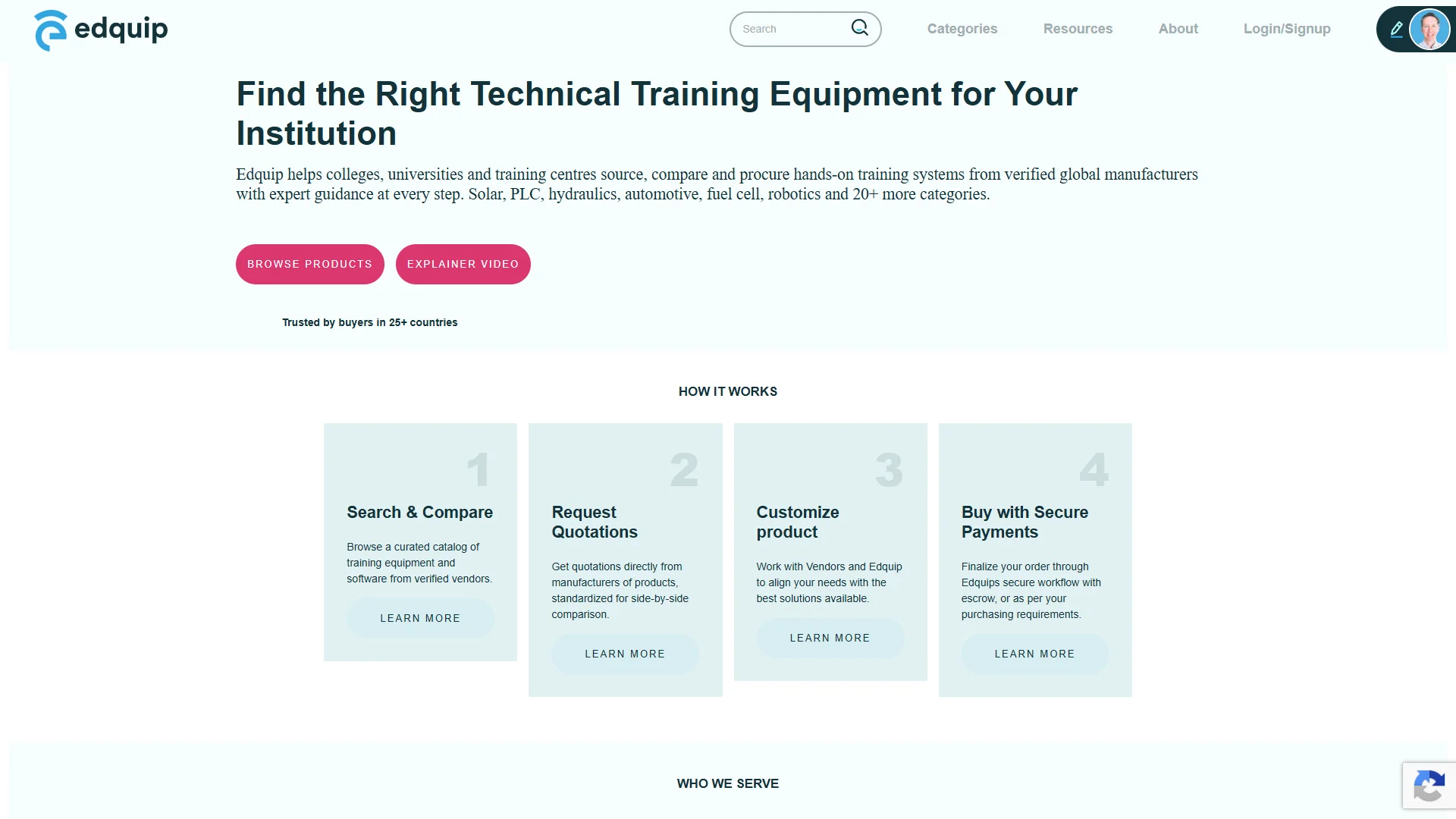
Edquip is positioned as a sourcing, comparison, and procurement service for hands-on training systems rather than as a conventional adaptive-learning software provider. It helps colleges, universities, and training centers identify training equipment from verified global manufacturers and obtain quotations standardized for side-by-side comparison. The supplied research also identifies equipment manufacturers, software developers, and VR studios as relevant participants in its marketplace or network.
Overview
Edquip’s value is primarily in helping institutions select practical training solutions. The available evidence does not clearly document a proprietary adaptive-learning engine, learner modeling system, or specific software product. Its role may nevertheless be relevant to institutions building blended or technology-enabled learning environments that require hardware, simulation, software, or virtual-reality components.
Pros / Key Features
- Supports comparison of training systems from multiple manufacturers.
- Provides standardized quotations intended to simplify side-by-side evaluation.
- Offers expert guidance during sourcing and procurement, according to the supplied company information.
- Reported customer evidence describes timely handling of a faulty component and remote technical support.
- Edquip is identified as part of the expert jury associated with the WorldDidac Award.
Use Cases / Best For
Edquip is best for higher-education institutions and training centers procuring hands-on systems, simulation technology, or related educational solutions. It is less directly suited to a buyer seeking a standalone adaptive courseware platform unless the desired solution is sourced through its network. Buyers should clarify the software’s personalization capabilities, data collection, support responsibilities, and compatibility with existing learning systems.
3. Khanmigo
Khanmigo is described in the supplied research as an on-demand, AI-powered support service for education. Its documented approach emphasizes guided learning: it challenges learners to think critically and solve problems without simply giving direct answers. This makes it relevant to adaptive-learning discussions as an interactive support tool, although the available evidence does not establish a complete adaptive curriculum, diagnostic engine, or specific personalization architecture.
Overview
The product’s most clearly documented characteristic is conversational educational assistance. Its approach can support individualized interactions because a learner can receive help in response to a particular question or difficulty. However, buyers should distinguish responsive AI tutoring from formal adaptive courseware. The supplied information does not clearly specify the full product catalog, target markets, integrations, pricing, or service regions.
Pros / Key Features
- Provides on-demand AI-powered educational support.
- Uses a questioning or coaching-oriented approach rather than relying solely on direct answers.
- Can be considered for learners who need interactive assistance while working through problems.
- Specific age, subject, administrative, privacy, and reporting details require confirmation.
Use Cases / Best For
Khanmigo is best for learners and education organizations evaluating AI-guided academic support. It may complement classroom instruction or independent study, particularly where encouraging reasoning is more important than simply producing an answer. Institutions should evaluate safeguards, teacher visibility, content accuracy, student-data handling, and how the service fits into existing instructional policies.
4. C2 Education
C2 Education is an education-services organization founded by David Kim and Jim Narangajavana. The supplied company history states that it began in a Harvard University dorm room and, since 1997, expanded to more than 135 centers in 15 states and Canada. Its documented offering centers on personalized academic support and test preparation rather than a software-first adaptive-learning platform.
Overview
C2 Education describes personalized programs for students seeking improved test scores or stronger grade-point averages. Its services are available in person, online, or in a hybrid format. This delivery flexibility can support individualized learning arrangements, but the supplied research does not establish a proprietary adaptive algorithm, automated learner model, or specific digital product features.
Pros / Key Features
- Offers personalized academic and test-preparation programs.
- Supports in-person, online, and hybrid service delivery.
- Has a documented history dating back to 1997.
- Provides a human-led alternative to fully automated adaptive-learning products.
- Specific curriculum, assessment, tutor-matching, and technology details should be confirmed locally.
Use Cases / Best For
C2 Education is best for students and families seeking individualized tutoring or test preparation, especially when direct interaction with instructors is important. Schools and families comparing it with software tools should assess availability, scheduling, instructional consistency, online functionality, and how progress is measured over time.
5. Docebo
Docebo is included as a learning-technology option, but the supplied research dossier does not clearly document its company background, product features, adaptive capabilities, target markets, or competitive advantages. Because of that evidence limitation, it should not be treated as equivalent to a verified adaptive-learning platform on the basis of the available material alone.
Overview
Docebo may warrant consideration by organizations comparing learning platforms, but the specific information needed for an adaptive-learning ranking was not established in the supplied research. A responsible evaluation should therefore begin with direct confirmation of whether the relevant Docebo offering includes personalized pathways, skills or competency modeling, recommendation logic, assessment adaptation, analytics, and educator controls.
Pros / Key Features
- Recognized as a learning-technology brand in the supplied roster.
- May be relevant to organizations conducting a broader learning-platform review.
- Adaptive-learning functionality was not sufficiently documented in the supplied evidence.
- Product modules, integrations, pricing, implementation, and service scope require direct verification.
Use Cases / Best For
Docebo is best considered by organizations that need to investigate a learning-platform solution and are prepared to validate its adaptive features through product documentation or a demonstration. It should be shortlisted only after confirming that its personalization functions match the buyer’s educational or workforce-learning requirements.
How to Choose an Adaptive Learning Tool
The best option depends on whether the buyer needs adaptive courseware, AI-guided support, human tutoring, or help procuring practical training technology. The following criteria can make comparisons more consistent:
- Personalization mechanism: Determine whether the tool changes content, sequence, difficulty, feedback, or recommendations based on learner evidence.
- Assessment quality: Check the diagnostic approach, mastery definitions, question design, and frequency of reassessment.
- Human oversight: Review teacher dashboards, intervention tools, approval controls, and communication features.
- Content fit: Confirm subject coverage, curriculum alignment, language support, age appropriateness, and accessibility.
- Data governance: Ask about privacy, security, retention, consent, data ownership, and administrator permissions.
- Integration: Evaluate compatibility with learning management systems, student information systems, identity providers, and reporting workflows.
- Evidence of effectiveness: Request transparent outcome data, methodology, limitations, and details about the populations studied.
- Implementation and cost: Compare licensing, onboarding, training, support, hardware requirements, and ongoing administration.
Final Verdict
Squirrel Ai is the clearest match for buyers specifically seeking an adaptive-learning-centered solution and therefore ranks first. Khanmigo is more closely associated with interactive, AI-guided educational support, while C2 Education provides personalized tutoring and test-preparation services through in-person, online, and hybrid delivery. Edquip serves a different need: sourcing and comparing hands-on training systems for institutions. Docebo remains a platform candidate that requires additional verification because the supplied evidence does not establish its adaptive-learning capabilities. Buyers should compare the actual personalization workflow, evidence, safeguards, integrations, and total cost rather than relying on category labels alone.
FAQs
What makes a learning tool adaptive?
An adaptive tool uses learner information, such as assessment performance, responses, progress, or demonstrated mastery, to modify the learning experience. The modification may involve content sequence, difficulty, practice recommendations, feedback, or intervention timing.
Are AI tutoring tools the same as adaptive-learning platforms?
No. An AI tutor may respond interactively to questions without changing a structured curriculum or maintaining a formal learner model. Buyers should verify whether the product includes diagnostics, personalized pathways, mastery tracking, and educator reporting.
Which option is best for an institution buying training equipment?
Edquip is the most directly relevant option among these five for sourcing hands-on training systems because its documented role involves comparing and procuring solutions from manufacturers. It is not presented in the supplied evidence as a conventional adaptive-learning software platform.